
THIS SITE IS IN 'PRE-LAUNCH' AND IS STILL UNDER CONSTRUCTION.
This is NOT a production-ready site (yet). Stay tuned.....
USTA Yin to GAMA Yang
GAMA is great for the industry, Publishers, Manufacturers and more. USTA aims to focus on the PLAYER and the DESIGNER (Pre-publisher).
Yin-Yang to GAMA
To be the "Yin" to GAMA’s "Yang," you first have to understand exactly what GAMA is. Despite their recent branding shift to "GAMA: The Tabletop Game Association," their core DNA remains a 501(c)(6) Trade Association.
In the nonprofit world, a 501(c)(6) exists to improve business conditions. It is a "Business League." GAMA’s primary "Yang" is focusing on the supply side of the industry: manufacturers, retailers, and distributors.
To be the player-centric and designer-centric "Ying," you should aim for the demand/creative side. Here is how you can structure your organization to intentionally contrast and complement GAMA.
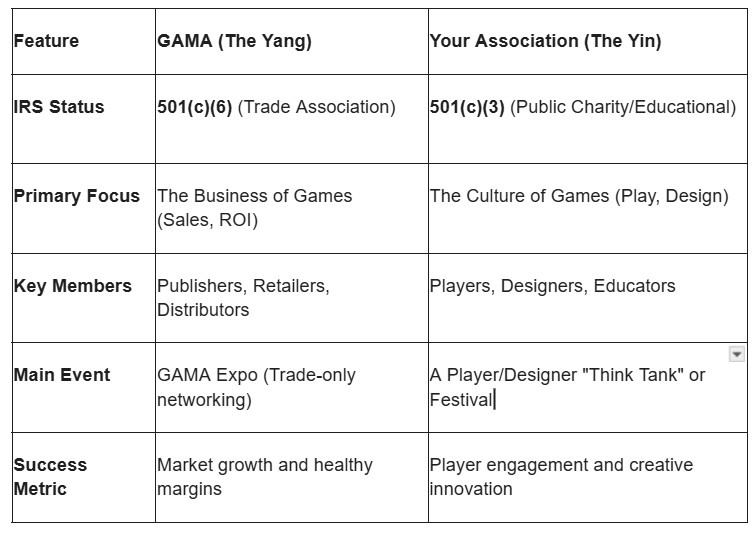
1. The Comparison: GAMA (Yang) vs. Your Vision (Yin)
(see CHART image below)
2. Why 501(c)(3) is your "Yin" superpower
If you form a 501(c)(3) Public Charity, you unlock several tools that GAMA (as a business league) cannot easily use:
Tax-Deductible Donations: You can solicit "Game Development Grants" or "Scholarships" from wealthy donors or corporations who want a tax break.
Educational Mission: You can legally focus on "Educating the public on the benefits of tabletop gaming" or "Teaching the art of game design."
Grant Eligibility: Most major foundations (like the NEA or STEM-focused grants) only give money to 501(c)(3)s.
Neutral Ground: Because you aren't a "business league," you can act as a neutral arbiter for the industry, focusing on what is good for the game, not just what is good for the sale.
3. Designing your Governance for "Perpetuity"
To ensure this organization continues for the "good of the industry" after you are gone, your Bylaws are your most important document. You should consider a Member-Elect Board model:
Designated Board Seats: Instead of a general election, "lock" specific seats. For example:
2 Seats for Active Game Designers
2 Seats for Community Organizers/Players
2 Seats for Academic Researchers/Educators
Staggered Terms: Board members serve 3-year terms, but only 1/3 of the board is up for election each year. This prevents a "hostile takeover" and ensures the mission doesn't shift overnight.
Term Limits: Limit board members to two consecutive terms. This forces new blood (and new ideas) into the association, preventing it from becoming a "boys' club."
4. The "Designer" Bridge
While GAMA has a "Creator" membership, it's often geared toward designers who are already small businesses. Your "Yin" approach can focus on the Pre-Commercial Phase:
Standardizing playtesting protocols.
Creating a "Designer Bill of Rights" or ethics code.
Providing mental health or creative resources for designers before they even have a publisher.
Next Step for You
To get this moving, would you like me to help you draft a "Purpose Statement"? This is the one-sentence "North Star" we would put on your IRS application to prove you are an educational/charitable entity (Yin) rather than just another business league (Yang).
By the way, to unlock the full functionality of all Apps, enable Gemini Apps Activity.
To create the "Ying" to GAMA’s "Yang," your purpose statement needs to shift the focus from commerce (GAMA's focus on buying/selling) to culture, education, and the creative process.
For a 501(c)(3), the IRS requires that you are organized for "exempt purposes" (like education or the advancement of the arts). Below are three versions ranging from the legal "IRS-friendly" version to a more inspirational "public-facing" version.
Option 1: The IRS-Standard "Foundational" Statement
Use this for your Articles of Incorporation and Form 1023 application.
"The [Association Name] is organized exclusively for charitable and educational purposes, specifically to advance the art and science of tabletop game design and to provide public education on the cognitive, social, and cultural benefits of tabletop gaming. Our mission is to support the creative development of game designers and to foster a globally connected community of players through research, educational programming, and the preservation of gaming history."
Why this works: It uses keywords like "Educational," "Science," and "Art," which are safe harbors for 501(c)(3) approval. It clearly defines the beneficiaries (designers and the public) without mentioning "industry profits."
Option 2: The "Yin-Yang" Balanced Statement
Use this for your website and membership materials to explicitly contrast with GAMA.
"While the industry focuses on the business of games, we focus on the soul of play. The [Association Name] exists to empower the creators who dream up our worlds and the players who bring them to life. We bridge the gap between design and experience by providing designers with the resources to innovate and players with the community to thrive, ensuring the tabletop medium continues to evolve as a vital tool for human connection."
Why this works: it sets you up as the "creative/community" side of the coin. It highlights "human connection," which appeals to donors and grant-makers.
Option 3: The "Perpetuity" Statement
Use this if you want to emphasize that the board-led structure is for the long-term health of the hobby.
"To protect and advance the future of tabletop gaming by serving as a permanent, board-governed resource for game designers and the playing public. We are dedicated to ensuring that the creative standards, ethical practices, and community values of the tabletop industry are preserved and championed for generations of gamers to come."
Why this works: It emphasizes "permanent" and "board-governed," signaling to the IRS and future members that this isn't a "cult of personality" around a founder, but a sustainable institution.
How to use these in your Bylaws:
To ensure the board-led "Yang" stays in check, I recommend adding a "Dissolution Clause" in your bylaws that matches this statement. It should say:
"Upon the dissolution of the association, all assets shall be distributed for one or more exempt purposes within the meaning of section 501(c)(3) of the Internal Revenue Code."
Pages
The United States Tabletop Association (USTA) is organized exclusively for educational and charitable purposes.
Our mission is to advance the art and science of tabletop game design and to provide public education regarding the cognitive and social benefits of structured play.
© 2026 USTA - United States Tabletop Association - All Rights Reserved.